
Small, well-documented claims add up — here’s how to keep more of what’s yours without crossing the ATO.
If you’re wondering how to get a bigger tax refund this year, the good news is that most Australians leave money on the table — not through some clever loophole, but simply because they don’t claim everything they’re legitimately entitled to. A refund isn’t a bonus from the government; it’s your own money coming back because you paid more tax during the year than you actually owed.
The path to a bigger tax refund comes down to two things: claiming every deduction you’re allowed, and keeping records solid enough to survive an ATO review. Below are nine practical, ATO-aligned strategies we use with clients every tax season, current as at the 2025–26 financial year — and it’s worth reading them alongside the FY26 tax changes so you’re working from the latest rules.
Written by the Tax NextGen Advisory Team
Registered Tax Agent No. 25664246 • 20+ years’ experience in Australian individual and small-business tax • Specialists in maximising work-related and investment deductions. This article reflects ATO guidance as at the 2025–26 financial year. Have a question about your situation? Contact our team.
1. Claim every work-related expense you’re entitled to
Work-related expenses are the single biggest source of missed deductions. The rule is simple: you can claim a cost if you spent the money yourself, weren’t reimbursed, it directly relates to earning your income, and you have a record to prove it.
In our experience, the categories people most often overlook include:
- Union fees, professional association memberships and subscriptions to work-related journals or apps
- Protective clothing, occupation-specific uniforms and laundry of those items
- Sun protection (sunscreen, sunglasses, hats) for people who work outdoors
- Tools and equipment, and the work-use portion of your phone and internet
- Work-related portion of a bag or briefcase used to carry work items
Worked example: what a deduction is actually worth
A deduction reduces your taxable income, not your tax bill dollar-for-dollar. If you claim $3,000 in work expenses and your top marginal rate is 30%, you get back roughly $900 (plus a little on the Medicare levy). At a 37% marginal rate, the same $3,000 is worth about $1,110. So a “$3,000 claim” is real money — just not $3,000 in your pocket.
2. Nail your working-from-home deduction
If you work from home, you can choose between two methods — and picking the right one can noticeably change your refund.
Fixed rate method: 70 cents per hour worked from home, which bundles electricity, gas, internet, phone and stationery into one figure. You can still separately claim the decline in value of equipment like a desk or computer.
Actual cost method: claim the real work-related portion of each running expense. More paperwork, but often a bigger deduction if you have a dedicated home office.
Watch out: for the fixed rate method the ATO now requires a record of the actual hours you worked from home across the whole year — an estimate or a “typical week” is no longer accepted. Keep a diary or timesheet as you go.
3. Claim self-education and professional development
If a course, seminar, conference or qualification has a sufficient connection to your current job — maintaining or improving the skills you already use, or likely to increase your income in that role — the costs are generally deductible. That can include course fees, textbooks, stationery, and travel to and from study.
The old rule that made the first $250 of self-education non-deductible has been removed, so you can now claim from the first dollar. The catch: study to get a new job in a different field usually isn’t deductible, because it relates to income you don’t yet earn.
4. Make a personal super contribution before 30 June
This is one of the most powerful and most underused strategies. You can make a personal contribution to your super fund and claim it as a tax deduction, up to the annual concessional contributions cap of $30,000 for 2025–26. (The ATO has confirmed this cap rises to $32,500 from 1 July 2026 — but for the 2025–26 return you’re lodging now, $30,000 is the limit.) That cap includes what your employer pays, so factor in the super guarantee (12% from 1 July 2025).
We regularly see clients use the carry-forward rule too: if your total super balance was under $500,000 at 30 June of the prior year, you may be able to use unused cap amounts from up to five earlier years, allowing a larger one-off deductible contribution.
Don’t skip this step: to claim the deduction you must lodge a valid Notice of Intent to Claim with your fund and receive their acknowledgement before you lodge your return. Miss it, and the deduction is lost.
5. Claim depreciation on tools, equipment and devices
Buying something for work? How you claim depends on the cost:
✓ $300 or less: claim the full work-related amount immediately this year.
✓ Over $300: claim the decline in value (depreciation) across its effective life — laptops, monitors, office furniture, power tools and more.
People routinely forget to claim depreciation in the second and later years of an asset’s life. If you bought a $1,500 laptop last year, there’s very likely still a deduction sitting in this year’s return.
Know what each deduction is really worth
Every deduction is worth more the higher your tax bracket. Download our free 2025–26 Tax Slabs Cheat Sheet to see the current rates at a glance and work out your marginal rate before you lodge.
Get the Free Cheat Sheet6. Maximise investment and rental property deductions
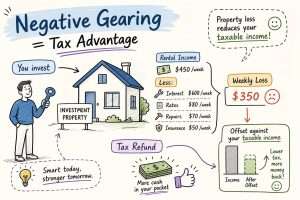
If you own an investment property or shares, a large share of your deductions lives here. For rentals, that includes loan interest, council rates, insurance, property management fees, and repairs & maintenance. Two big-ticket items are often understated: capital works (broadly, 2.5% of eligible construction cost per year under Division 43) and plant & equipment depreciation (Division 40) on assets like air conditioners, hot water systems and carpets. Our investment property tax guide walks through the full list of rental deductions, and if you’re weighing up a quantity surveyor’s report, see whether a depreciation report is worth it for your property.
Repair vs improvement: a genuine repair (fixing what’s broken) is deductible now; an improvement (upgrading beyond the original) is capital and claimed over time. Getting this wrong is a common trigger for ATO review, so document the work carefully.
7. Claim your charitable donations
Donations of $2 or more to a registered Deductible Gift Recipient (DGR) are tax deductible — and the receipts add up faster than people expect over a year. Keep every receipt, and remember it must be a genuine gift.
✗ Not deductible: raffle or art-union tickets, chocolates or items bought at a fundraiser, and anything where you received something of value in return.
8. Deduct income protection premiums and the cost of managing your tax
Two dependable deductions many people miss:
- Income protection insurance premiums are generally deductible where the policy is held outside super and covers loss of income. (Life, trauma and TPD cover generally are not.)
- The cost of managing your tax affairs — including your registered tax agent’s fee — is deductible in the following year’s return.
9. Keep bulletproof records — and lodge with a registered agent
Every strategy above depends on one thing: proof. The ATO can ask you to substantiate a claim, so no record generally means no deduction. It also already receives a surprising amount of your data — here are 9 things the ATO already knows about you before you lodge. Use the myDeductions tool in the ATO app or a simple folder, and capture receipts as you go rather than scrambling in July.
A registered tax agent then makes sure nothing is missed and everything is defensible — the surest route to how to get a bigger tax refund without the sleepless nights. Tax NextGen prepared tens of thousands of returns last year, and we see the same missed deductions again and again.
For context, here are the resident marginal rates that determine what each deduction is worth (2025–26 resident rates, excluding the 2% Medicare levy):
| Taxable income | Tax on this income |
|---|---|
| $0 – $18,200 | Nil |
| $18,201 – $45,000 | 16c for each $1 over $18,200 |
| $45,001 – $135,000 | $4,288 + 30c for each $1 over $45,000 |
| $135,001 – $190,000 | $31,288 + 37c for each $1 over $135,000 |
| $190,001 and over | $51,638 + 45c for each $1 over $190,000 |
Key Takeaways: 9 ways to a bigger tax refund
- Claim all eligible work-related expenses — and don’t forget the small ones.
- Choose the right working-from-home method and log your actual hours.
- Claim self-education tied to your current role, from the first dollar.
- Make a deductible personal super contribution before 30 June (lodge the Notice of Intent).
- Depreciate assets over $300 — including in later years.
- Capture every rental deduction, including capital works and depreciation.
- Claim donations of $2+ to registered DGRs.
- Deduct income protection premiums and your tax agent fee.
- Keep records all year and lodge with a registered agent.
Prefer to talk in your own language? Our team supports clients in multiple languages — explore our language support options.
Ready to get a bigger tax refund?
Let our registered tax agents find every deduction you’re entitled to and lodge with confidence.
Start Your Tax ReturnMaximum legal refund • ATO-compliant • Registered tax agents.
This article provides general information only and does not constitute personal tax, financial or legal advice. It reflects our understanding of ATO guidance as at the 2025–26 financial year; tax rules continue to evolve and may be subject to legislation. You should seek advice tailored to your circumstances before acting. Tax NextGen — Registered Tax Agent No. 25664246.