If you’ve ever wondered what you can claim on your investment property tax return in Australia, you’re not alone, it trips up even experienced landlords. The rules aren’t complicated once you see the full picture, but the ATO divides every rental expense into one of three categories: claim now, claim over time, or can’t claim at all. Put something in the wrong bucket and you either leave money on the table or expose yourself to ATO scrutiny. At Tax NextGen, our Chartered Accountants work through this categorisation with property investors every tax season, and the same misclassifications come up repeatedly. This guide covers the full framework so you know exactly where your expenses sit before you lodge.
One rule applies to every category: you can only claim rental property expenses for periods when the property is rented or genuinely available for rent. If you use it privately or leave it vacant without actively seeking tenants, those days don’t count.
What you can claim on your investment property tax return, immediate deductions
Many landlords find that immediate deductions provide the most near-term tax benefit. These are the ordinary, recurring costs of running a rental property, and the ATO’s list is longer than most landlords realise.
The ATO’s list of immediate deductions
For the 2025, 26 financial year, the following expenses are immediately deductible against your rental income:
- Advertising for tenants
- Council and water rates
- Body corporate fees
- Land tax
- Cleaning, gardening, and pest control
- Insurance premiums (building, contents, public liability, and loss of rent)
- Property management fees and commissions
- Interest on investment loans
- Repairs and maintenance
- Bank charges
- Legal expenses not related to acquisition or borrowing
- Quantity surveyor’s fees
- Lease preparation costs
The practical test for each expense is simple: does it relate directly to earning your rental income? If a cost exists because you own a rental property, it almost always belongs in this column. Keep every invoice and statement, because the ATO expects you to substantiate every claim you make.
The $300 rule for low-cost assets
Depreciating assets that cost $300 or less can be written off immediately in the year of purchase rather than depreciated over several years. A replacement ceiling fan, a new blind for a bedroom window, or a basic smoke alarm all fall into this category. If the item costs more than $300, it needs to go onto a depreciation schedule and be claimed over its effective life instead. The threshold is applied per asset, not per invoice, so separate items purchased together are assessed individually.
Investment loan interest: what landlords can and cannot claim
Interest is often one of the largest deductions available to Australian landlords, and understanding it properly is worth real money at tax time.
How interest deductions work in practice
Only the interest portion of your loan repayments is deductible. Principal repayments are not deductible because they reduce a debt, not your taxable income. The deduction applies for any period the borrowed funds are being used for the income-producing property, which in most cases means the full year if your loan is dedicated to the rental.
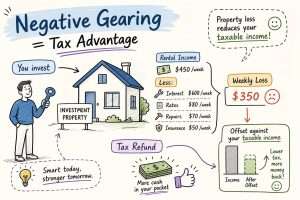
This is also where negative gearing enters the picture. When your total rental expenses, including interest, exceed your rental income for the year, the net loss offsets your other taxable income, such as your salary. That reduction in overall taxable income is the mechanism behind negative gearing, and interest is usually the expense that pushes the numbers into loss territory.
When interest must be apportioned
If a loan serves both the rental property and a private purpose, you can only claim the portion of interest that relates to the rental use. A common example is a line of credit used to fund a rental renovation and a private holiday in the same period. The interest on the holiday funds is private and non-deductible; only the interest on the renovation funds qualifies. Mixing personal and investment borrowings in the same account is a pattern the ATO scrutinises closely, and poor records make it very difficult to defend your claim.
Repairs vs improvements: a distinction that costs landlords real money
This is the area where most rental property errors occur, and the financial consequences can be significant. The ATO draws a deliberate and specific line between repairs and improvements. The tax treatment on either side of that line is completely different.
What the ATO considers a deductible repair
A repair restores the property to its former condition after wear, damage, or deterioration. Fixing a broken window, repainting peeling walls, mending a leaking pipe, replacing a section of damaged guttering, and repairing a patch of damaged flooring are all repairs. They are fully deductible in the year you pay for them, provided the property is rented or available for rent at the time the work is done.
What counts as a capital improvement instead
An improvement goes beyond restoring the original condition. It upgrades, betters, extends the useful life of the property, or replaces an entire structure rather than repairing part of it. Replacing a basic kitchen with a full renovation, adding a deck, installing ducted air conditioning where none existed, or replacing an entire roof are all improvements. These costs cannot be deducted immediately; they are claimed over time through capital works or plant and equipment depreciation, which is covered in the next section.
The initial repairs trap
Work done to fix defects that existed when you purchased the property is treated as capital, not a repair, even if you carry out the work after the property is first rented. This trips up a significant number of investors who buy older properties and spend money on obvious issues shortly after settlement. The ATO classifies that work as part of the cost of acquiring the property, not as maintenance during the rental period. At Tax NextGen, this is one of the most frequent misclassifications we see and correct, so it is worth getting right from the start.
How depreciation works for your investment property tax return in Australia
Australian tax law separates depreciation into two distinct streams, and you need to understand both to claim everything you are entitled to. Miss either stream and you leave money unclaimed.
Division 43: capital works deductions (the building itself)
Division 43 covers the building structure and fixed structural improvements such as fences, driveways, and retaining walls. For residential properties where construction commenced after 15 September 1987, the deduction rate is 2.5% per year over 40 years. The deduction is calculated on the original construction cost, not the price you paid to buy the property, and only for the proportion of the year the property produces rental income. If you don’t know the construction cost, a quantity surveyor can estimate it.
Division 40: plant and equipment (removable assets)
Division 40 covers depreciating assets that are not part of the structure, carpets (effective life of 8 years under TR 2022/1), hot water systems (12 years), ovens (12 years), blinds, and other removable items. Each asset is depreciated based on its ATO-determined effective life using either the prime cost or diminishing value method. There is a critical rule change to be aware of: second-hand plant and equipment items in established residential properties purchased after 9 May 2017 generally cannot be depreciated by the new owner. Only brand-new items installed after settlement are eligible for Division 40 claims in those properties.
Why a depreciation schedule matters
A quantity surveyor’s depreciation schedule is the most reliable way to capture every eligible Division 43 and Division 40 claim for your specific property. Without one, most landlords underestimate or entirely miss their depreciation entitlements. The quantity surveyor’s fee is itself immediately deductible, and for many properties, particularly those with significant fixtures or recent construction, the deductions the schedule uncovers can substantially outweigh its cost.
Mixed use and private use: how to apportion your claims
Not every property is rented year-round, and some are used privately for part of the year. When that’s the case, your expense claims need to reflect the split between rental use and private use.
Time-based apportionment for partial-year rentals
When a property is rented for part of the year and privately used or genuinely vacant for the rest, expenses are apportioned by dividing the number of days rented (or genuinely available for rent) by the total days in the year. “Genuinely available” is the phrase the ATO focuses on. Advertising the property at an unreasonably high asking price, limiting bookings to specific people, or leaving it vacant without actively marketing it are not accepted as genuine availability. The ATO looks at the facts, not the intention.
Holiday homes and the private use rules
Holiday homes attract close ATO scrutiny. If you use the property privately for any period, the expenses attributable to that period are not deductible. Depending on the facts, the ATO applies time-based apportionment, area-based apportionment, or a combination of both. Keep a clear calendar recording rental nights, owner-use nights, and genuinely vacant nights throughout the year. That record becomes your evidence if the ATO ever asks questions.
What you cannot claim and when to get a professional review
Knowing the exclusions is just as important as knowing the deductions. Several costs that landlords commonly try to claim are specifically off limits under ATO rules.
Expenses the ATO does not allow
The purchase price of the property, conveyancing fees, stamp duty on purchase, and selling costs are not deductible as rental expenses. They form part of your cost base for capital gains tax purposes and only become relevant when you eventually sell. Travel to inspect or maintain a residential rental property has not been deductible since 1 July 2017 for individual investors, regardless of how far you travel or how necessary the trip was. The depreciation of second-hand plant and equipment in established properties purchased after May 2017 is also off the list, as noted above. Any expense with a genuinely private element, whether in whole or in part, cannot be claimed to the extent of that private use.
How a Chartered Accountant can protect every legitimate claim
Investment property tax returns involve more moving parts than a standard employment return. Depreciation schedules, interest apportionment, repairs versus capital improvement calls, mixed-use periods, and the 2017 rule changes all interact with each other, and an error in one area often creates a problem in another. The Chartered Accountants at Tax NextGen review every expense category before lodging your return, which means nothing legitimately deductible gets missed and nothing disallowable slips through.
A phone consultation can surface deductions you weren’t aware you had and correct classification errors before the ATO identifies them. No office visits are required, and the initial consultation is free. If you haven’t lodged a return for prior years, Tax NextGen can also help you catch up with amended and late lodgements.
Getting your investment property tax return right from the start
When you ask what you can claim on your investment property tax return in Australia, the answer spans three areas: what you can claim immediately, what you must depreciate over time, and what you cannot claim at all. These three areas, repairs versus improvements, interest apportionment, and depreciation, are where most errors occur and where most savings hide.
If you don’t have a depreciation schedule for your property, obtaining one is often a high-return step, particularly where Division 40 or Division 43 entitlements are likely. If you’re unsure where any of your expenses sit, speaking with a qualified tax professional before lodging is the safest and most financially sound approach.
Tax NextGen offers a free initial phone consultation for property investors across Australia. Get in touch with our team to go through your rental property expenses and make sure your return captures everything you’re entitled to.