

How depreciation can be the largest unclaimed deduction in your rental property return — and when to get a report.
Depreciation is arguably the most valuable and most frequently missed deduction available to Australian rental property investors. It requires no cash outlay. It generates deductions year after year. And it can add thousands of dollars to your annual tax refund. Understanding rental property depreciation Australia rules is one of the simplest ways to improve your return — and Tax NextGen reviews depreciation for every rental property client.
Written by the Tax NextGen Advisory Team
Registered Tax Agents (No. 25664246) with 20+ years of experience preparing investment property tax returns. This article reflects current ATO rules as at the 2025–26 financial year, including the post-2017 plant and equipment changes. Contact our team for advice on your specific circumstances.
What Is Building Depreciation?
The ATO allows investment property owners to claim a tax deduction for the gradual wear and tear of the building and its assets over time. This deduction is called capital works or building depreciation — and it is split into two categories, Division 43 and Division 40, which together make up the core of rental property depreciation Australia claims.
1. Division 43 — Capital Works (Building Write-Off)
Division 43 covers the structural elements of the building: the walls, roof, floor, built-in fixtures, common areas, and major renovations. The deduction rate is 2.5% per year of the original construction cost.
Conditions:
- ✓ The building must have been constructed after 18 July 1985 for residential investment properties
- ✓ The deduction continues for 40 years from the date of construction
- ✓ Applies regardless of when you purchased the property — you just need the original construction cost (or an estimate from a quantity surveyor)
Example: An apartment constructed for $350,000 in 2010. Division 43 deduction: $350,000 × 2.5% = $8,750 per year. Over 10 years of ownership, that's $87,500 in additional deductions.
2. Division 40 — Plant and Equipment
Division 40 covers the removable or mechanical assets inside the property: carpets, appliances, hot water systems, air conditioning units, blinds, curtains, smoke detectors, ceiling fans, and so on. Each asset depreciates at its own rate over its effective life — as specified by the ATO in its effective life tables.
3. The Post-2017 Changes — Who Is Affected?
From 7 May 2017, the rules for Division 40 plant and equipment changed significantly for residential investment property.
- Second-hand property bought after 7 May 2017: You can only claim Division 40 depreciation on brand-new assets you personally purchased and installed. You cannot claim depreciation on pre-existing plant and equipment that was in the property when you bought it.
- Brand-new property: Division 40 can still be claimed on all qualifying assets, regardless of when the property was purchased.
- Division 43 is not affected: The building write-off applies to all investment properties regardless of when they were purchased, or whether they are new or second-hand.
4. How Much Does a Depreciation Report Cost — and Is It Worth It?
A tax depreciation schedule prepared by a registered quantity surveyor typically costs $500–$800 for a residential investment property. What it generates:
- ✓ A detailed schedule of all depreciable assets in the property
- ✓ Calculated annual depreciation deductions for Division 40 and Division 43
- ✓ A 40-year forecast of all deductions
For a recently constructed apartment or house:
- • Division 43 alone may generate $6,000–$12,000+ in annual deductions
- • Division 40 may add another $2,000–$5,000 in the early years
- • Combined deductions of $8,000–$15,000 per year in the early years of ownership are common
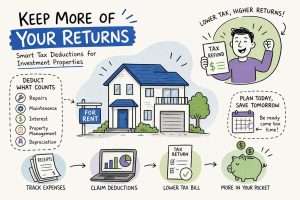
The payoff: At a 37% marginal rate, $10,000 of additional depreciation deductions saves around $3,700 in tax — in a single year. The report typically pays for itself within the first few months of ownership.
Free Download
IT Professional's Tax Health Check Checklist
15 questions every employee, contractor, and freelancer should ask before lodging their tax return.
Download NowWhat About Older Properties?
For properties constructed before 1985, Division 43 does not apply. Division 40 may still be available for plant and equipment (subject to the post-2017 rules for second-hand properties). The value of a depreciation report for an older second-hand property is more limited, but worth assessing with a quantity surveyor or your accountant.
5. Depreciation and Negative Gearing
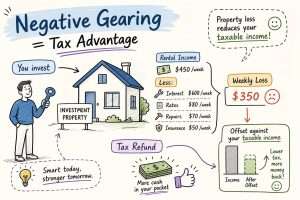
Depreciation deductions contribute to the negative gearing position of your investment property. Because depreciation is a non-cash deduction (it doesn't represent money you actually spent), it can create or increase a rental loss even in years where the property's rental income comes close to covering the cash costs.
This is a significant planning advantage — the tax deduction is real, even though the underlying "loss" did not involve actual cash leaving your account.
What Happens to Depreciation When You Sell?
When you sell an investment property, any Division 40 and Division 43 deductions that were claimed affect your cost base and may affect your CGT calculation:
- Division 43 deductions do not directly reduce your cost base — but they do affect the CGT calculation in more complex ways that your accountant should address at sale time.
- Division 40 deductions on plant and equipment may create a taxable balancing adjustment at the time of sale if the assets are sold for more than their depreciated value.
Tax NextGen coordinates with clients approaching property sales to ensure the depreciation history is correctly incorporated into the CGT calculation. For a full breakdown of how the capital gain itself is worked out, see our guide on shares, ETFs and capital gains tax.
Key Takeaways
- ✓ Division 43 gives 2.5% per year of construction cost, for 40 years from the build date
- ✓ Division 40 covers removable assets, each depreciating over its effective life
- ✓ Post-2017 rules limit Division 40 on second-hand residential properties
- ✓ A $500–$800 QS report often pays for itself in the first few months
- ✓ Depreciation boosts negative gearing as a genuine non-cash deduction
Not Originally From Australia?
Don't worry! We speak in your language.
Investment Property? Tax NextGen Finds Every Deduction
100% Max Refund Guaranteed · 7 Days Refund · 24 Hours Processing · 20+ Years
Book a Free ConsultationDisclaimer: Information contained in this publication is general in nature and has been prepared for information purposes only. It does not constitute legal, taxation, or financial advice. Professional advice should be sought before acting on any information contained in this publication.



One Response