
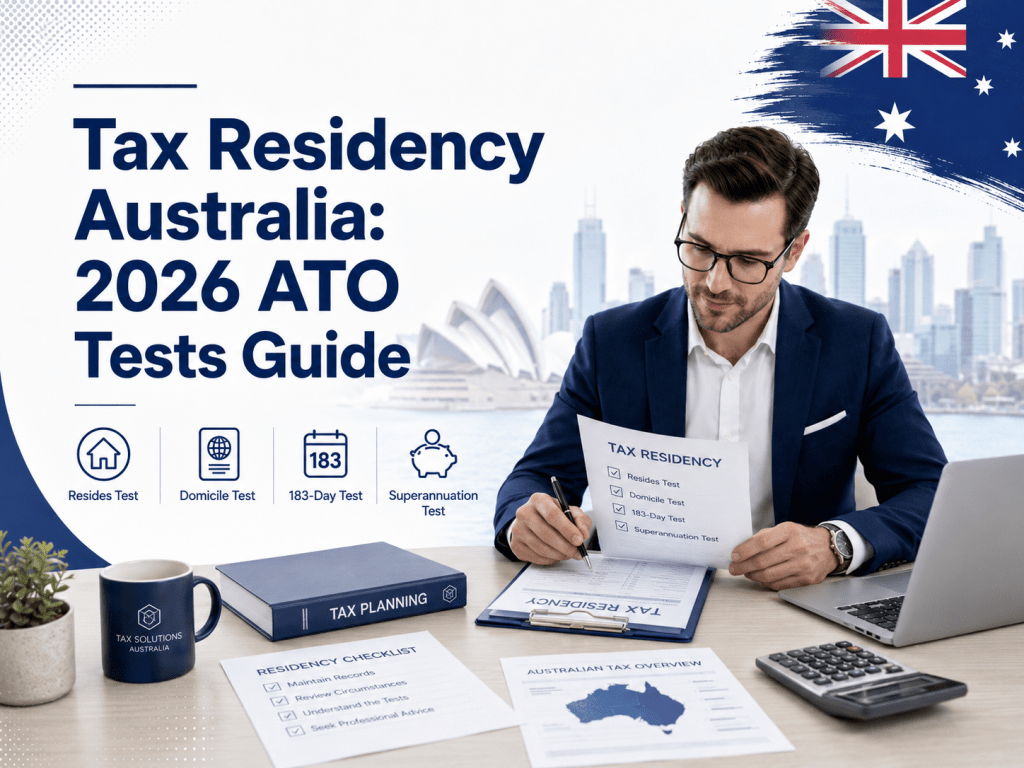
How residency status changes your tax rates, offsets, and the 50% CGT discount.
If your living situation, visa status, or travel pattern changed during the year, your tax residency Australia position might have changed too — and that can significantly affect your 2025 tax position.
At Tax NextGen, we often see clients who have moved between visas, split time between countries, or obtained permanent residency mid-year, unaware that their tax rules shifted. A tax return agent Australia can help review these changes before lodgement. Let's explore what residency means, why it matters, and what recent cases are teaching us.
Why Tax Residency Matters
Your tax residency Australia determines how much of your income the ATO taxes, which offsets you can claim, and whether you qualify for the 50% CGT discount on investments like shares or crypto.
If you're an Australian tax resident, you:
- ✓ Declare your worldwide income (Australian and foreign)
- ✓ Can claim the tax-free threshold and certain tax offsets
- ✓ May access the 50% CGT discount for assets held longer than 12 months
- ✓ Are subject to the Medicare levy unless exempt
If you're a non-resident, you:
- • Pay tax only on Australian-sourced income
- • Do not receive the tax-free threshold
- • Generally cannot claim the CGT discount (unless under specific grandfathered rules)
- • Usually do not pay the Medicare levy
The difference can be significant — and in some cases, clients who were incorrectly treated as non-residents ended up facing backdated assessments and penalties once their circumstances were reviewed by the ATO.
Visa Holders' Tax Survival Guide 2026
Everything visa holders and new arrivals need to know about residency, foreign income, and CGT before lodging this year.
Get the Free GuideHow the ATO Determines Residency
There isn't one single test or "magic number of days." The ATO considers several tests to determine your residency status, each with a different focus. A tax agent Australia can assess these tests against your actual circumstances.
The "Resides" Test
The main test asks whether you "reside" in Australia in the ordinary sense — whether Australia is where you live, keep your home, and maintain personal, family, and social connections.
The "Domicile" Test
If your permanent home (domicile) is in Australia, you'll generally be treated as a resident unless you have a permanent place of abode outside Australia.
The "183-Day" Test
Spending more than 183 days in Australia in a financial year may make you a resident, unless you can demonstrate a permanent home elsewhere.
These tests are applied together, and the final outcome depends on your overall pattern of life — not just your visa status or number of days.
Common Situations Where Residency Changes Mid-Year
Because many clients work across borders or change visa types, residency can shift during the year. Common examples include:
- Gaining permanent residency mid-year: You may be a non-resident for part of the year and a resident thereafter. Your taxable income, offsets, and CGT calculations may need to be apportioned.
- Working under an ABN or TFN while travelling: Your residency depends on where your home and business base are, not just where you perform the work.
- Owning shares or crypto: Ceasing or resuming residency can trigger "deemed disposal" events, affect your CGT discount, and change reporting obligations.
- Investment properties: Residents must declare both Australian and foreign rental income, while non-residents report only Australian-sourced rent.
Each of these situations requires careful timing analysis — when exactly your residency changed can affect your tax bill and future entitlements.
Recent Residency Cases — What the Courts Are Focusing On
Recent Administrative Review Tribunal decisions show that residency disputes are often about facts, intention, and evidence rather than visa labels.
- Quy v Commissioner of Taxation [2025] ARTA 174: The taxpayer worked overseas but retained strong ties in Australia, including family and property. The Tribunal held he remained an Australian resident.
- Kirtlan v Commissioner of Taxation [2025] ARTA 539: The taxpayer claimed to be non-resident but failed to declare large foreign income. The Tribunal found he remained resident and imposed penalties.
- Abotomey v Commissioner of Taxation [2025] ARTA 719: The Tribunal found the taxpayer resumed Australian residency not when he physically returned, but when he formed the intention to permanently return.
These cases highlight that:
- ✓ Residency depends on connections, continuity, and intention, not just physical presence
- ✓ The ATO will look closely at where your family lives, where you maintain your home, and whether you intend to live abroad indefinitely
- ✓ Good documentation and clear evidence of your situation can be critical if the ATO reviews your residency
Practical Checklist — What to Review
If your circumstances changed during the 2025 financial year, review the following before lodging your return:
- ✓ Did your visa or residency status change during the year?
- ✓ How many days were you physically in Australia, and where did you live when overseas?
- ✓ Do you maintain a home, family, or property in Australia?
- ✓ Do you have ongoing ties such as bank accounts, memberships, or health insurance?
- ✓ Did you earn foreign income or hold assets overseas?
- ✓ Do you hold shares, crypto, or investments that may be affected by a change in residency?
- ✓ Have you kept records of travel dates, accommodation, and correspondence showing your intention to stay or leave?
These records are essential if the ATO ever asks you to substantiate your position.
Key Tax Differences: Resident vs Non-Resident
| Category | Resident | Non-Resident |
|---|---|---|
| Tax-free threshold | Yes | No |
| Tax rates | Lower | Higher |
| CGT 50% discount | Yes (if asset held >12 months) | No (for most assets) |
| Scope of income | Worldwide | Australian-sourced only |
| Medicare levy | Usually payable (unless exempt) | Generally not payable |
For example, if you arrived in Australia mid-year on a 485 visa and spent 200 days here, your tax rate, offsets, and CGT entitlements will depend on whether you became a resident from your arrival date or later — a timing detail that can change your refund or liability significantly. Reviewing your tax return Australia position early can help avoid surprises.
Capital Gains Tax and Residency
For clients with shares, crypto, or property, residency affects how capital gains are calculated:
- • Residents can generally access the 50% CGT discount for assets held longer than 12 months
- • Non-residents cannot use the discount for most assets and may face CGT on taxable Australian property only
- • If you cease residency, you may trigger a deemed disposal of certain assets (like overseas shares or crypto). This can be deferred with an election, but the timing and valuation are critical
Understanding these consequences before you move or change status can prevent unnecessary tax or double-counting later. If you hold rental property, our investment property tax return service can help ensure foreign and Australian rent are reported correctly.
What the Recent Trends Tell Us
Residency disputes are becoming more common, especially as more Australians work remotely or split time between countries. The ATO now cross-matches immigration data, travel records, and overseas financial disclosures, so inconsistent reporting is easily detected.
Recent cases demonstrate that residency is not just a formality — it is a factual, evidence-based question that can have large financial impacts if misunderstood.
How Tax NextGen Can Help
If you changed visa, travelled abroad, or gained PR in 2025-2026, it's essential to review your residency position before you lodge your return. At Tax NextGen, our tax consultant Australia and tax agent Melbourne team can help you understand your tax residency Australia position. We:
- ✓ Assess your residency under all ATO tests, based on your actual circumstances
- ✓ Review your mix of employment, ABN, investment, and crypto income to ensure correct treatment
- ✓ Identify timing issues for CGT and foreign income
- ✓ Advise on Medicare levy exemptions and partial-year tax calculations
- ✓ Provide written documentation of your residency analysis for future ATO reviews
Final Thoughts
Residency is one of the most misunderstood areas in personal taxation — and one of the most important. Whether you've just arrived, recently gained PR, or maintain investments overseas, the ATO will always look at your facts, not just your visa.
If your circumstances changed in 2025, we recommend discussing your situation with your advisor before you lodge. It could mean the difference between a smooth refund and an unexpected tax bill. A professional review of your tax residency Australia status can give you clarity before lodgement.
A Short Consultation Now Can Prevent Costly Reassessments Later
100% Max Return Guaranteed · 7 Days Refund · 24 Hours Processing · 20+ Years
Book Your Free Tax Residency ReviewDisclaimer: Information contained in this publication is general in nature and has been prepared for information purposes only. It does not constitute legal, taxation, or financial advice. Professional advice should be sought before acting on any information contained in this publication.